
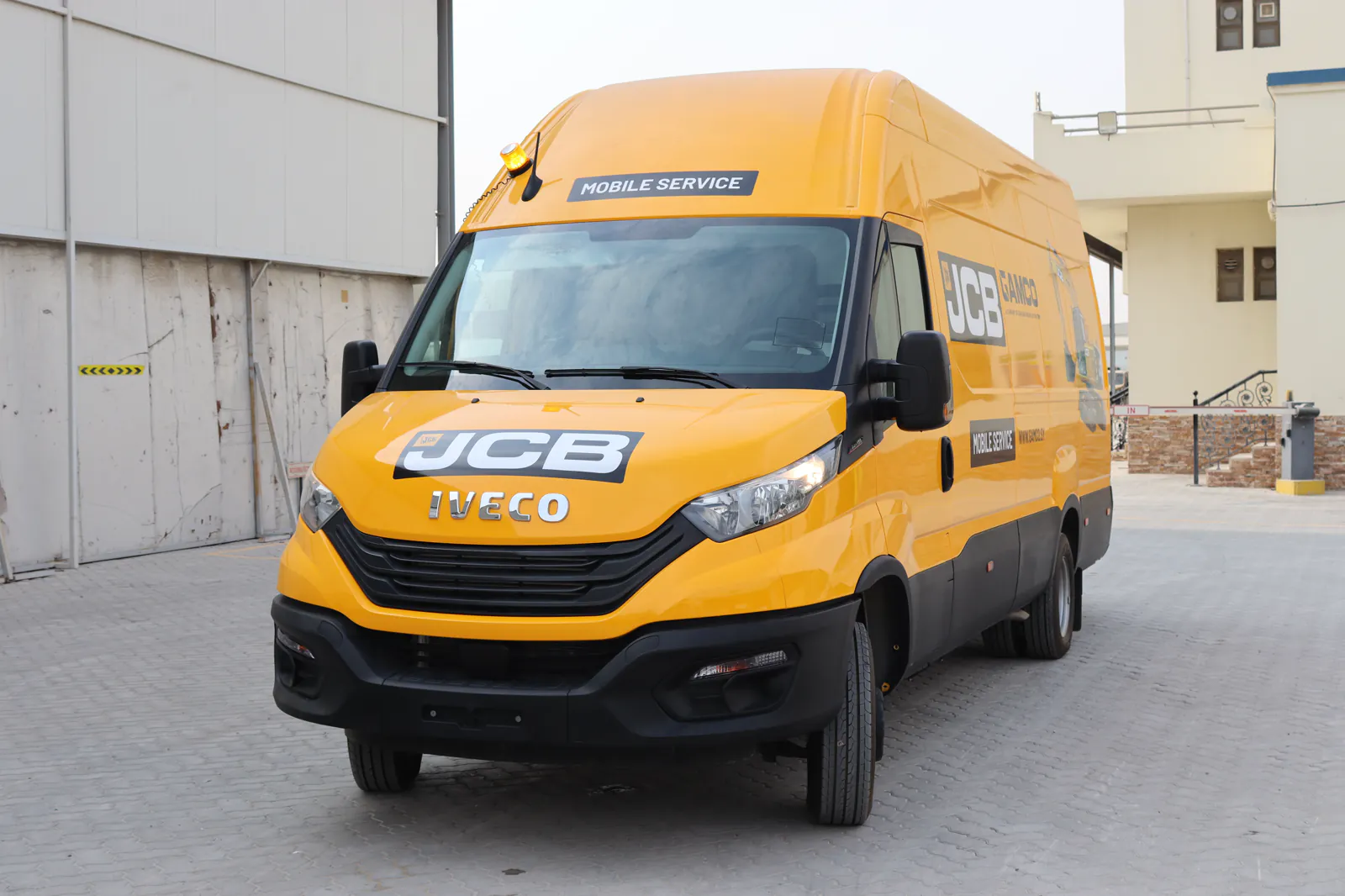
Customized trucks and mobile workshop vehicles, built around the job.
Heavy-duty mobile workshop vehicles fitted out in the UAE with integrated workstations, organised storage and rugged construction — so your team can work on site instead of returning to the workshop.
A working workshop that travels with the crew.
Al Furat designs and fabricates customized trucks and mobile workshop vehicle conversions in the UAE for industrial, construction, maintenance and remote-site requirements. Each build takes a commercial chassis or van body and turns it into a self-contained working space: a lined cabin with an integrated workstation, shelving, a workbench and a shadow board, so tools stay organised and within reach. These industrial service vehicles suit teams working away from a fixed base — maintenance crews, field-service engineers and contractors — where the cost is time lost travelling back for a tool, a part or a bench. Layout follows the work the vehicle has to do, then the fit-out is fabricated to survive the environment it will do it in.
- Configured around a specific operational brief, not a fixed catalogue layout
- Internal storage and workstation, plus external accessories such as roof racks and toolboxes
- Rugged construction intended for demanding industrial environments
Designed around the job, not the vehicle.
Every build starts with the work. We look at what the crew carries, what they use most often, and what has to be reached first — then plan the internal layout around that sequence rather than filling the body with generic racking.
Frequently used equipment sits within reach of the door. Heavier items are mounted low and secured. Panels, benches and mounts are fabricated to hold their alignment while the vehicle is working, because a fit-out that loosens on rough ground stops being useful quickly.
- Customer-specific requirements captured before layout begins
- Internal layout planned around access and frequency of use
- Durable fabrication and secure equipment mounting
- Organised storage that keeps the crew productive on site
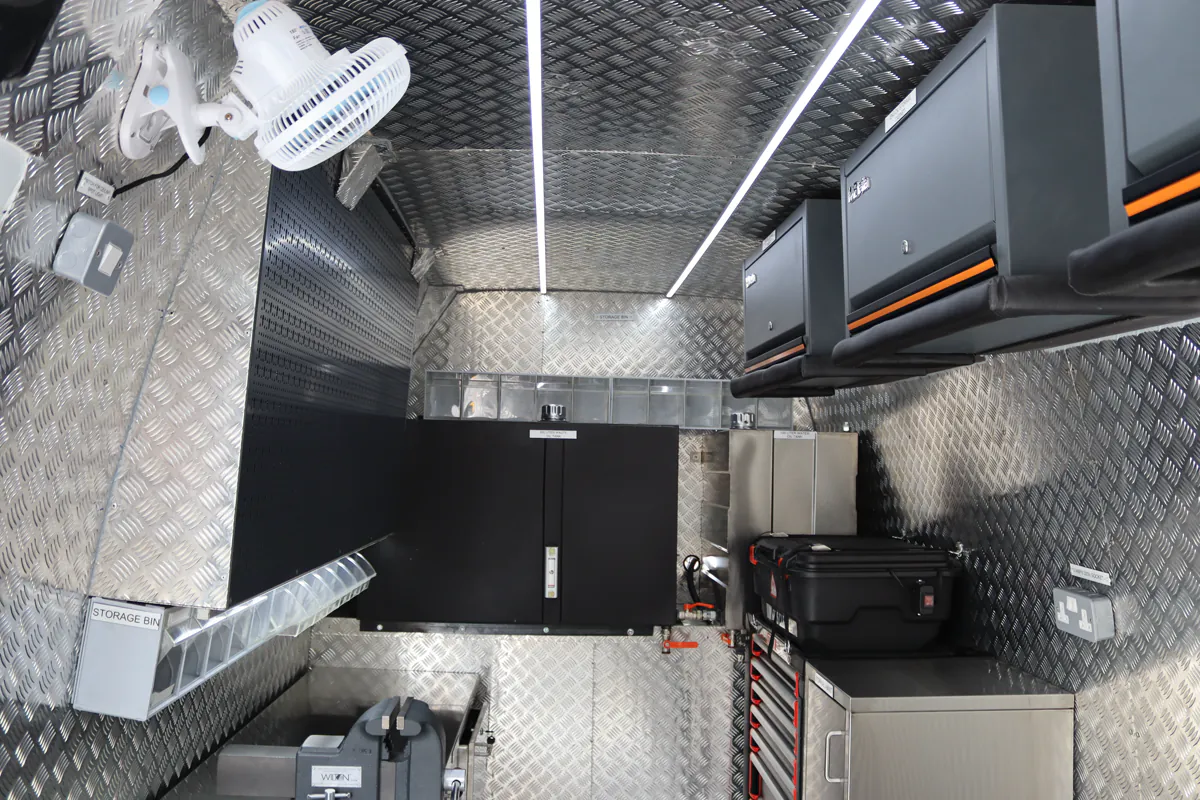
Mobile workshop configurations.
The options below are drawn from vehicles we have built. Which of them suit your vehicle depends on the body size, the equipment you carry and how the crew works, so configurations are confirmed per project rather than sold as a fixed package.
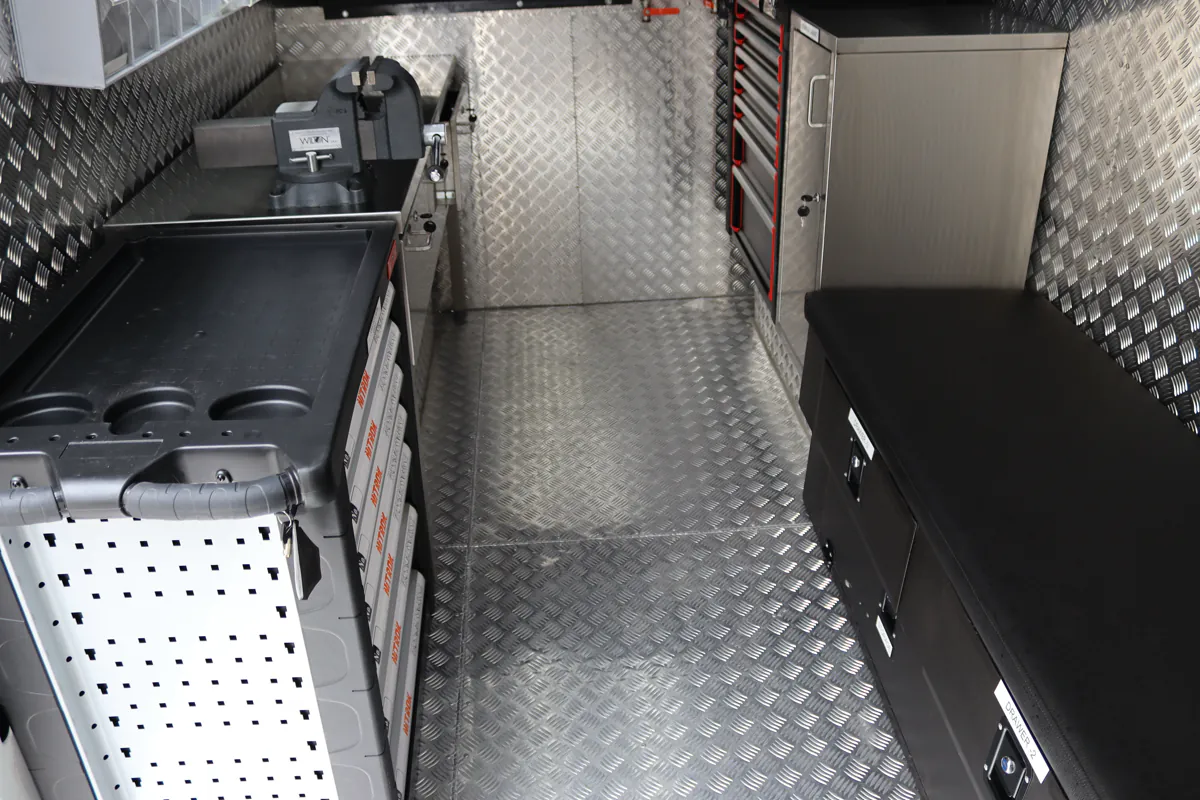
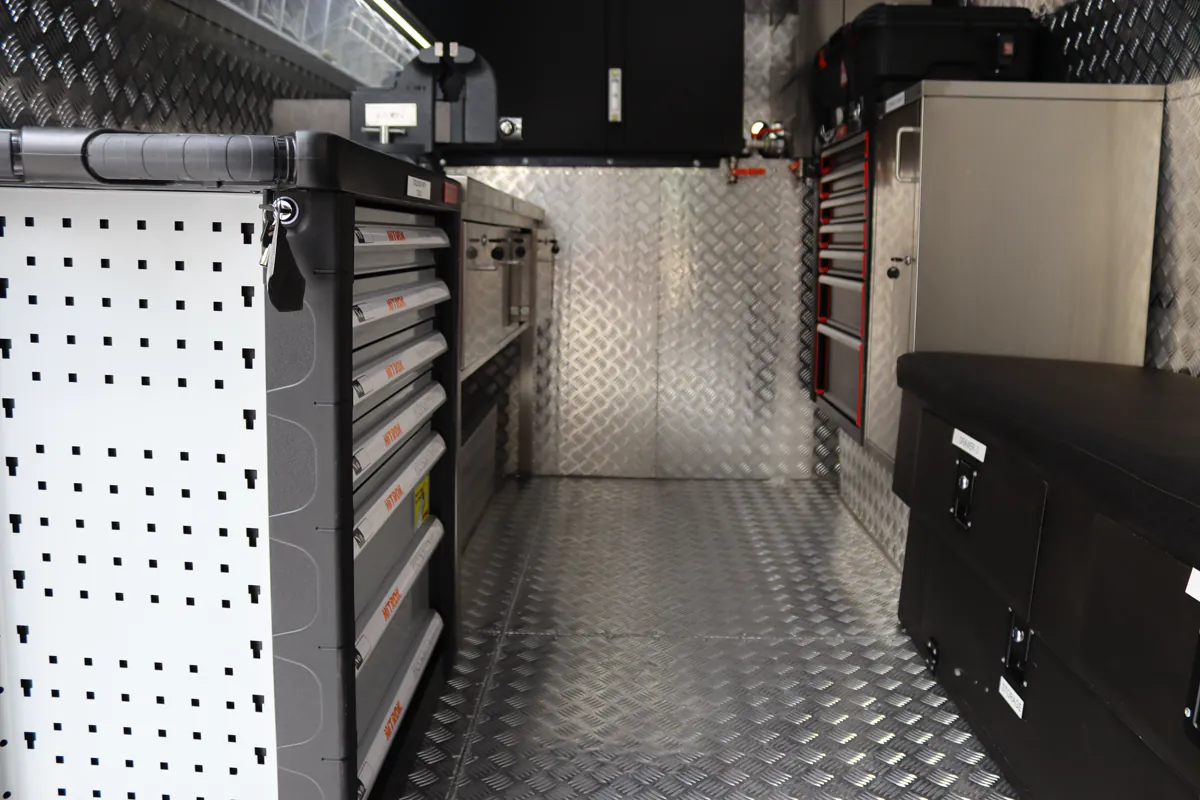
Integrated workbench
A fixed working surface inside the body, with a vice mounted where there is room to work around it.
Shelving & drawers
Shelving and multi-drawer units sized to the parts and consumables the crew carries.
Shadow board
A perforated panel that keeps hand tools visible, so missing items are noticed before leaving site.
Internal workstation
A defined work position combining bench, storage and lighting within the cabin.
External toolboxes
Externally accessed boxes for items that should not take up cabin space.
Roof racks
Roof-mounted carriers for long or bulky items such as ladders and pipework.
Equipment mounting
Secure mounting for equipment carried on board, positioned for access and stability.
Cabin lining & lighting
Hard-wearing wall and floor lining with interior lighting for work after dark.
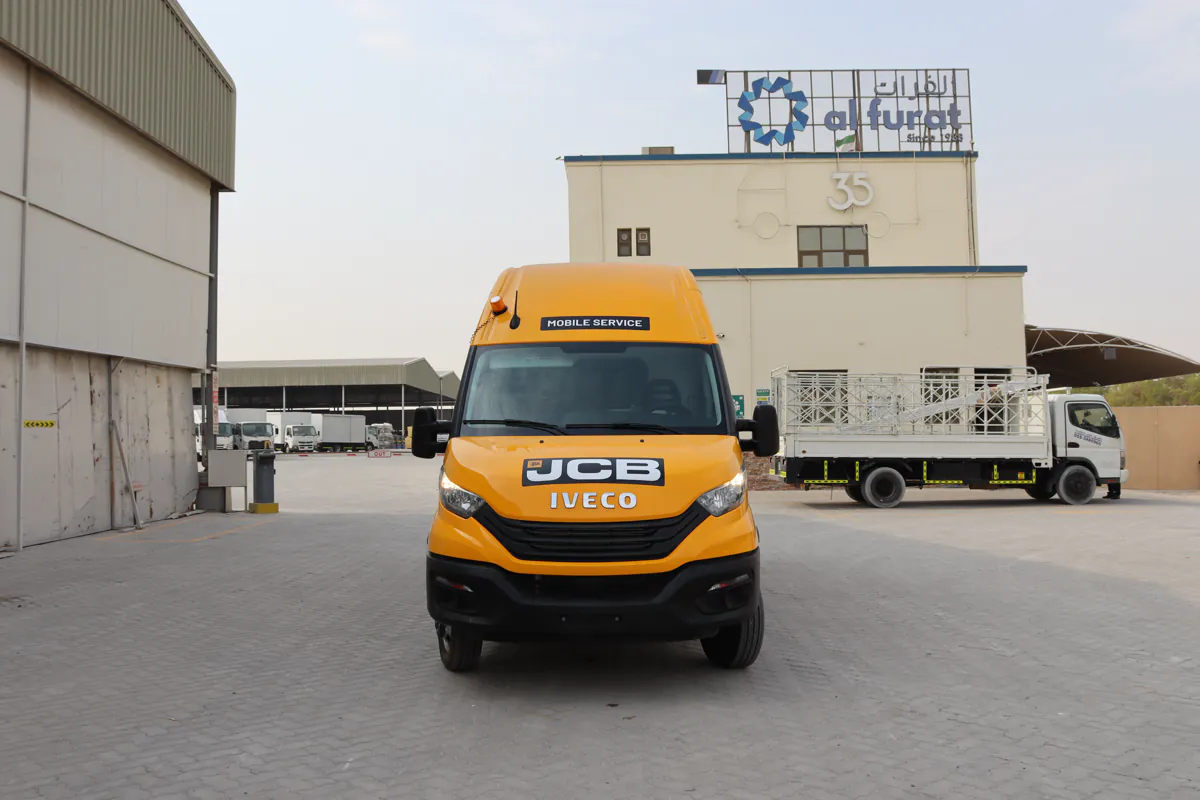
Take the workshop to the work.
These vehicles are built for rugged industrial environments and for reaching sites that a standard service vehicle struggles to serve. Specified with off-road capability, they are intended to travel rocky trails, muddy tracks and steep inclines to reach remote construction and service locations.
The point is straightforward: the tools, the bench and the working space arrive with the crew, so work can begin on arrival rather than after a return trip.
- Built for demanding industrial and construction environments
- Specified for access to remote and difficult sites
- Rocky, muddy and steep terrain considered in the specification
- Tools and workspace delivered directly to the jobsite
Where these vehicles work.
The configurations shown here suit teams who service, maintain or build away from a fixed base.
Construction-site support
On-site tooling and storage for crews working through a project programme.
Mobile maintenance
Scheduled and reactive maintenance carried out where the equipment stands.
Field-service operations
Service teams covering dispersed sites from a single, self-contained vehicle.
Utility & infrastructure projects
Work along routes and installations where a fixed workshop is impractical.
Remote industrial work
Locations reached over unmade tracks and rough ground.
Equipment & tool transport
Carrying tools and equipment securely and in order, ready to use on arrival.
How a build comes together.
A general project workflow for custom vehicle fabrication. Exact stages and timings are agreed per project.
Operational requirements
We go through the work the vehicle has to support: the crew, the equipment carried and the sites it must reach.
Vehicle and body layout
The chassis or van body is matched to the brief, and the internal layout is planned around access and working sequence.
Equipment and storage configuration
Bench, shelving, drawers, shadow board and external accessories are specified and positioned.
Fabrication and integration
Lining, structure, storage and mounts are fabricated and installed, and equipment is integrated into the body.
Inspection and handover
The completed build is checked over and handed to the operator.
A completed mobile workshop build.
Exterior, access, storage and workstation details from one delivered vehicle.
Common questions.
What can be customised on an industrial vehicle?
In a mobile workshop conversion, the internal layout and the external accessories. Inside, the workshop cabin can be configured with storage and an integrated workstation. Outside, accessories such as roof racks and toolboxes can be added. What suits your vehicle depends on the body and the work it has to do.
Can the vehicle include a mobile workstation?
Yes. An integrated workstation combining a workbench, shelving and a shadow board is a standard part of the fit-outs we build, positioned so the crew can work inside the body.
What storage options can be integrated?
Shelving, drawer units, cabinets and a shadow board internally, with externally accessed toolboxes where items are better kept outside the cabin. Sizes and positions are set by what you carry.
Can these vehicles be designed for remote worksites?
Yes. They are built for rugged industrial environments and can be specified for off-road use, so they can reach remote construction and service locations over rocky, muddy or steep ground.
Can roof racks, toolboxes and equipment mounts be included?
Yes. Roof racks and external toolboxes are common additions, and equipment carried on board can be securely mounted as part of the build.
What information is needed to start an enquiry?
The intended application, the vehicle or chassis you have in mind if any, the equipment and storage you need, the operating environment and the project location. That is enough for a first conversation.
Tell us what the vehicle has to do.
Send the details below and a member of the team will come back to you to work through the configuration.
- Intended application and the work the crew carries out
- Vehicle or chassis preference, if you already have one
- Equipment that has to be carried or mounted
- Storage requirements — shelving, drawers, benches, boards
- Operating environment, including off-road use
- Project location
Email the team directly and include as much of the above as you have. We will confirm what is practical before anything is quoted.